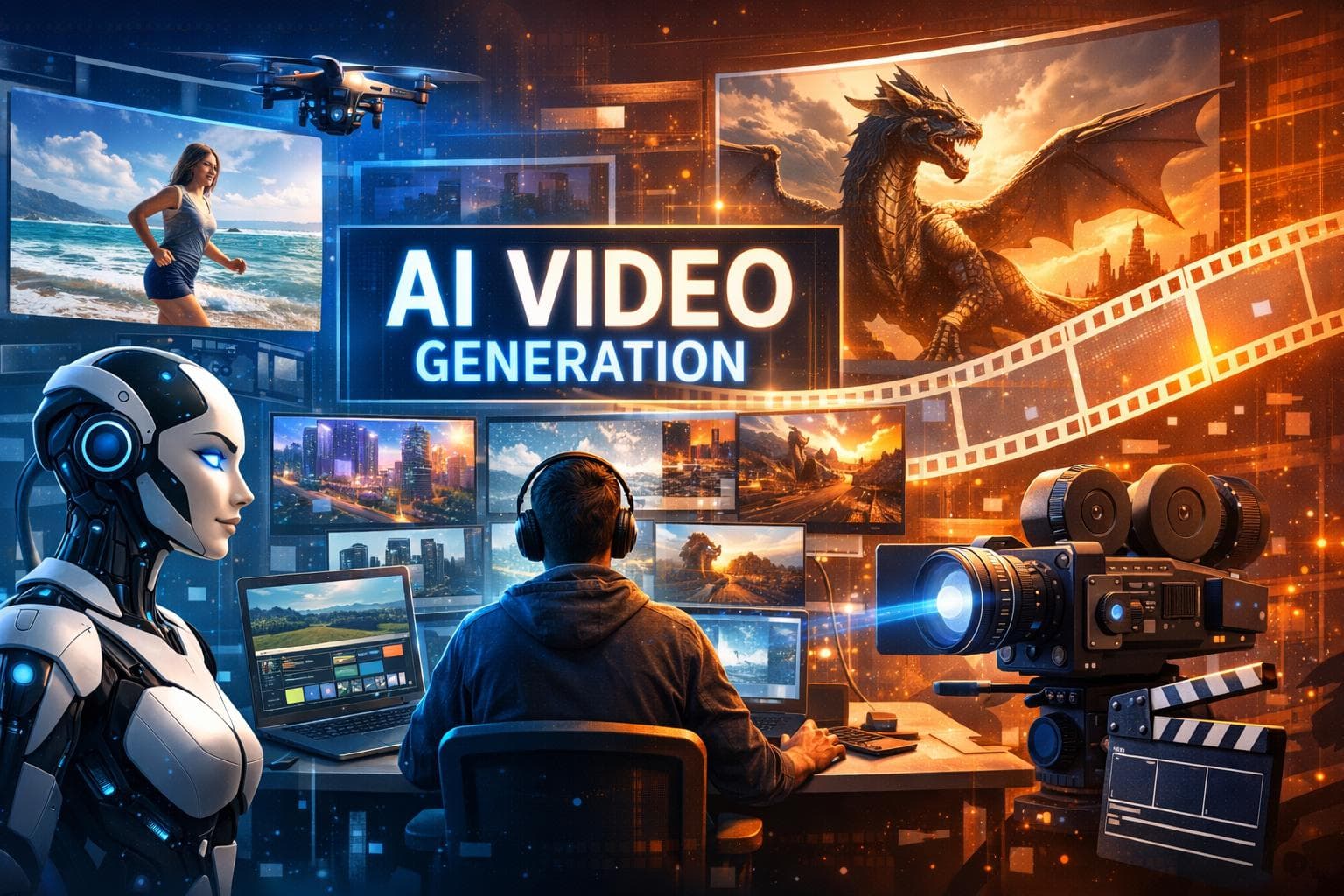
The AI Video Revolution: How Tools Like Sora and Runway Are Changing Content Creation Forever
The world of content creation has always been driven by innovation, but nothing has shaken the industry quite like the emergence of AI-powered video generation tools. Platforms such as OpenAI's Sora, Runway Gen-3, and other cutting-edge solutions are fundamentally rewriting the rules of what it means to produce video content. What once required a full production crew, expensive equipment, and weeks of post-production can now be achieved with a well-crafted text prompt and a few minutes of processing time. For creators, marketers, and businesses alike, this is not just an incremental upgrade — it is a paradigm shift that promises to democratize video production and unleash an unprecedented wave of creative expression.
The Rise of AI Video Generation Tools
AI video generation is not a brand-new concept, but the recent advancements have pushed it from experimental curiosity to practical reality. Runway was among the first platforms to make AI video editing and generation accessible to everyday creators. With its Gen-2 and later Gen-3 models, Runway introduced text-to-video capabilities that allowed users to generate short clips from simple descriptions. Then came OpenAI's Sora, which stunned the world with its ability to produce remarkably realistic, minute-long videos from nothing more than a written prompt.
Other notable players have also entered the arena. Pika Labs, Stable Video Diffusion, and Google's Veo are all competing to push the boundaries of what AI can achieve in video production. The competition is fierce, and each new release brings improved resolution, longer output durations, and more coherent motion. What seemed impossible just two years ago — generating a cinematic drone shot of a fictional city entirely from text — is now achievable in seconds.
How These Tools Actually Work
At their core, AI video generators rely on diffusion models, a type of generative AI architecture that learns to create content by progressively refining random noise into structured visual output. These models are trained on massive datasets of video and image content, enabling them to understand concepts like lighting, physics, motion, perspective, and even human emotions.
When a user types a prompt such as "a golden retriever running through autumn leaves in slow motion," the AI interprets the semantic meaning of each word and generates frames that match the description. More advanced tools like Sora go further by maintaining temporal coherence, meaning the motion between frames looks natural and fluid rather than glitchy or disjointed.
Some tools also offer image-to-video functionality, where a still photograph can be animated into a moving scene, and video-to-video editing, where existing footage can be restyled or transformed. Runway, for instance, allows creators to apply entirely new visual styles to their clips, turning a regular street scene into an animated painting or a science fiction landscape.
The Impact on Content Creators and Social Media
For content creators, particularly those active on platforms like Instagram, TikTok, and YouTube, AI video tools represent a massive opportunity. The biggest barrier to producing high-quality video content has always been cost and technical skill. Not everyone can afford a camera crew, professional lighting, or advanced editing software. AI video generation levels the playing field by putting Hollywood-grade visual effects within reach of a solo creator working from their bedroom.
Imagine a travel blogger who wants to illustrate a destination they have not yet visited, or a fitness influencer who needs dynamic B-roll to complement their tutorial. Instead of sourcing stock footage or spending hours filming, they can generate custom visuals tailored exactly to their vision. This not only saves time and money but also gives creators complete creative control over their visual output.
Social media algorithms reward video content heavily, and the ability to produce more videos, faster, means creators can post more consistently — a key factor in growing an audience. AI-generated content also opens the door to entirely new formats, such as AI-enhanced storytelling, visual podcasts, and immersive narrative experiences that blend real footage with generated elements.
Revolutionizing Marketing and Advertising
The marketing world is arguably the sector most immediately impacted by AI video tools. Producing a television commercial or a social media ad campaign traditionally involves scriptwriting, storyboarding, casting, filming, editing, and color grading. This process can take weeks and cost tens of thousands of dollars. With AI video generation, brands can produce multiple variations of an ad in a single afternoon, test them across different audiences, and iterate based on performance data.
Personalization is another game-changer. AI makes it possible to create localized versions of ads for different markets, adjusting visual elements, settings, and even the appearance of characters to resonate with specific demographics. A fashion brand could generate lookbook videos featuring diverse models in various global settings without organizing a single photoshoot. An e-commerce company could produce product demonstration videos at scale, showing their items in hundreds of different use cases.
Startups and small businesses, which previously could not compete with the production budgets of larger corporations, can now create polished, professional video content that rivals anything produced by a major agency. This democratization of advertising is reshaping competitive dynamics across every industry.
Ethical Considerations and Challenges
With great power comes great responsibility, and AI video generation is no exception. The ability to create hyper-realistic videos from text raises serious ethical questions. Deepfakes — AI-generated videos that convincingly depict real people doing or saying things they never did — represent a significant threat to public trust. While platforms like Sora and Runway have implemented safeguards and content policies, the underlying technology can be misused by bad actors.
Copyright is another thorny issue. Since these AI models are trained on existing video content, questions arise about whether the generated output infringes on the intellectual property of the original creators. The legal landscape is still evolving, and creators should stay informed about the terms of service and usage rights associated with each tool.
There is also the question of authenticity. As AI-generated content becomes more prevalent, audiences may begin to question what is real and what is fabricated. For creators who have built their brand on authenticity and transparency, it is important to be upfront about the use of AI in their content. Disclosing AI-generated visuals not only maintains trust with your audience but also sets a positive precedent for the industry as a whole.
The Creative Possibilities Are Limitless
Despite the challenges, the creative potential of AI video tools is staggering. Filmmakers are using these tools to pre-visualize scenes before committing to expensive shoots. Musicians are generating entire music videos from lyrical prompts. Educators are creating engaging visual content to explain complex topics. Game developers are prototyping cinematics without needing a full animation team.
One of the most exciting applications is the concept of "world building." With AI, a creator can generate consistent visual environments — fictional cities, alien landscapes, historical reconstructions — and use them across multiple pieces of content. This opens the door to serialized storytelling on social media, where each post or reel continues an ongoing narrative set in an AI-generated world.
Collaborative creation is also evolving. Some platforms now allow multiple users to contribute to and refine AI-generated videos, enabling a new form of co-creation that blends human creativity with machine capability. The result is content that neither humans nor AI could have produced alone.
How to Get Started with AI Video Tools
For creators looking to dive into AI video generation, the barrier to entry is surprisingly low. Most tools offer free tiers or affordable subscription plans that provide enough credits to experiment and learn. Here are some practical steps to get started:
First, define your creative goal. Are you looking to generate B-roll footage, create entire videos from scratch, or enhance existing content with AI effects? Your answer will determine which tool best suits your needs. Runway excels at video-to-video editing and style transfer, while Sora is more suited for generating entirely new scenes from text prompts.
Second, learn the art of prompt engineering. The quality of your output depends heavily on how you describe what you want. Be specific about camera angles, lighting conditions, color palettes, and the mood you want to convey. Instead of writing "a beach at sunset," try "a wide-angle cinematic shot of a deserted tropical beach at golden hour, with gentle waves lapping against white sand and palm trees swaying in a warm breeze."
Third, iterate and refine. AI video generation is not a one-shot process. Experiment with different prompts, compare outputs, and learn what each tool does best. The more you practice, the better you will become at directing the AI to produce exactly what you envision.
What the Future Holds
The AI video revolution is still in its early stages. Current tools produce clips that are typically 5 to 60 seconds long, but the trajectory points toward full-length video generation within the next few years. Real-time AI video generation — where content is created on the fly during live streams or interactive experiences — is already being explored by several companies.
Integration with other AI modalities is another frontier. Imagine combining AI video generation with AI voice synthesis and AI music composition to produce an entire short film — script, visuals, narration, and soundtrack — all from a single creative brief. This convergence of AI capabilities will create a new category of "full-stack" content creation that is faster, cheaper, and more accessible than anything we have seen before.
Conclusion
The AI video revolution is not coming — it is already here. Tools like Sora, Runway, and their competitors are fundamentally changing how content is conceived, produced, and distributed. For creators, marketers, and businesses willing to embrace these technologies, the opportunities are immense. Lower production costs, faster turnaround times, and limitless creative possibilities are just the beginning. However, with this power comes the responsibility to use it ethically, transparently, and in ways that enhance rather than erode the trust of your audience. The creators who thrive in this new era will be those who learn to harness AI as a creative partner — not a replacement for human imagination, but an amplifier of it.