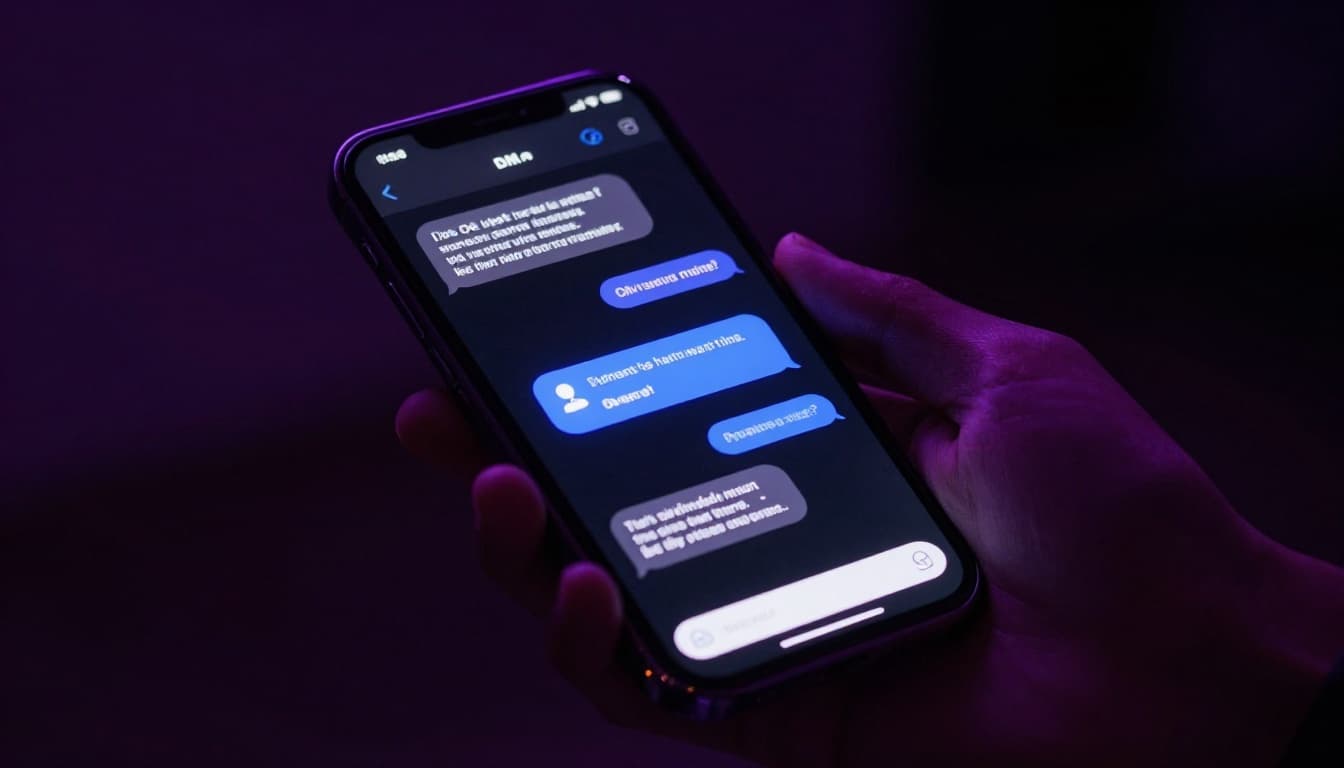
Dark Social: The Hidden Shares in DMs and Group Chats That You're Not Tracking
You publish a blog post. Your analytics show that it received 500 direct visits — people who supposedly typed your URL directly into their browser. You know that did not happen. Nobody memorizes and manually types out a URL like yoursite.com/blog/seven-strategies-for-growing-your-email-list. What actually happened is that someone shared your link in a WhatsApp group, a friend texted it to a colleague, someone dropped it in a private Slack channel, and a handful of people forwarded it via email. Your analytics platform had no way to trace the referral source, so it lumped all of those shares into "direct traffic" and called it a day. This invisible sharing ecosystem has a name: dark social. It represents the majority of content sharing happening online, and if you are making content strategy decisions based only on the metrics you can see, you are flying blind through the most impactful distribution channel your content has.
What Dark Social Actually Means
The term "dark social" was coined by Alexis Madrigal in a 2012 Atlantic article, and it refers to social sharing that occurs through private channels where referral data is not passed to analytics platforms. When someone shares your content on Twitter, Facebook, or LinkedIn by clicking the share button, your analytics can see exactly where that traffic came from. But when someone copies a link and pastes it into a WhatsApp message, an iMessage conversation, a Facebook Messenger chat, an email, a Discord server, or a Slack channel, the referral information is stripped away. Your analytics platform sees the visit but has no idea how the visitor found you. This is not a small phenomenon. Research from RadiumOne and subsequent studies have consistently found that dark social accounts for approximately 80 to 84 percent of all outbound sharing from publisher websites. That means for every share you can see in your analytics, there are four or five shares happening in the shadows that you cannot track. The content you think flopped because it got minimal social engagement might actually be your most shared piece — just through channels you cannot measure.
Why Dark Social Dominates Sharing Behavior
The dominance of dark social is not a technical accident — it reflects fundamental human communication preferences. People share content privately for reasons that are deeply different from why they share publicly. Public sharing on social media is performative — you are curating an image of yourself for your followers. Private sharing is genuine — you are sending something to a specific person because you think they will find it useful, interesting, or entertaining. The barrier to private sharing is much lower. You do not need to craft a caption, you do not worry about how it makes you look to your entire follower base, and you do not hesitate because the content might be controversial or niche. You just drop the link and send. Additionally, the rise of messaging apps as the dominant communication platform has accelerated dark social exponentially. WhatsApp has over two billion users. Facebook Messenger, iMessage, Telegram, Discord, and Slack collectively handle billions of messages daily. These are where real conversations happen, and when someone encounters content worth discussing, they share it through the same channels they are already using for conversation.
The Analytics Blind Spot
The practical consequence of dark social is that your analytics are systematically understating your content's reach and impact. This blind spot affects content strategy in several dangerous ways. First, you may kill content that is actually performing well. If a blog post gets minimal public social shares but generates significant dark social traffic that shows up as "direct" visits, you might conclude that the topic does not resonate and stop creating similar content — when in reality it was your most shared piece. Second, you may overvalue content that generates visible vanity metrics but does not drive meaningful sharing. A post that gets 200 likes on LinkedIn but zero private shares may actually be less impactful than a post that gets 30 likes but is forwarded to 50 people via email. Third, your attribution models are broken. If you are making advertising or content investment decisions based on last-click attribution, you are ignoring the dark social touchpoints that often precede the final conversion. Someone might discover your product through a link a friend sent in a group chat, visit your site (appearing as direct traffic), and convert three days later through a Google search — giving all the credit to SEO when dark social was the true catalyst.
Measuring the Unmeasurable
While you cannot track dark social with the same precision as public referral traffic, there are several strategies that provide meaningful directional data. The most effective approach is implementing shortened, trackable URLs for different distribution contexts. When you share a link in your newsletter, use one UTM-tagged URL. When you post it on Twitter, use another. When you embed it in your content for readers to share, use a clean URL with a unique tracking parameter. Any traffic that arrives without any of your tracked parameters is likely dark social. Tools like Bitly and UTM.io make this tagging process manageable. Another approach is to examine your direct traffic patterns. If you see spikes in direct traffic that coincide with content publication but do not correlate with any public social activity, you are likely seeing dark social in action. Pages with long, complex URLs that show high direct traffic are almost certainly benefiting from private sharing, since nobody types those URLs manually. Some analytics platforms have started offering dark social estimation features that analyze direct traffic patterns and estimate what percentage likely came from private sharing versus genuine direct visits.
Creating Content Optimized for Private Sharing
Understanding dark social changes how you think about content creation. Content that gets shared privately tends to have different characteristics than content that gets shared publicly. Publicly shared content is often identity-affirming — people share it because it makes them look smart, informed, or aligned with certain values. Privately shared content is utility-driven — people share it because it solves a specific problem for someone they know. Think about the last time you sent a link to a friend through a text message. It was probably something like "this explains exactly what we were talking about last night" or "you need to read this before your meeting tomorrow." The content was relevant to a specific person in a specific context. To optimize for dark social, create content that people want to send to one specific person. Highly practical how-to guides, data-driven analyses that settle debates, tools and resource lists, and opinion pieces that articulate a perspective someone agrees with but cannot express as clearly — these formats thrive in private channels because they serve as social currency in one-on-one conversations.
UTM Strategies for Dark Social Tracking
A well-designed UTM strategy is your best tool for bringing some visibility to dark social sharing. The principle is simple: tag every link you control so that any untagged traffic is likely dark social by elimination. Here is a practical framework. For every piece of content you publish, create tagged versions for each known distribution channel — your email newsletter, your social profiles, your paid campaigns, your partner promotions. Use consistent naming conventions so your analytics dashboards can aggregate data cleanly: utm_source identifies the platform, utm_medium identifies the channel type, and utm_campaign identifies the specific content piece. Any direct traffic that arrives without UTM parameters and lands on a specific content page (rather than your homepage) is almost certainly dark social. You can create a custom segment in Google Analytics that isolates this traffic: direct visits to content pages excluding the homepage and other commonly bookmarked pages. This segment gives you a reasonable approximation of your dark social traffic volume, allowing you to track trends over time and correlate spikes with content publication dates to understand which pieces generate the most private sharing.
Why Engagement Metrics Undercount Your True Reach
The dark social blind spot has a cascading effect on how creators and marketers perceive their true reach. When you look at a post that received 50 likes, 10 comments, and 3 public shares, you might conclude that approximately 2,000 to 5,000 people saw it based on typical engagement rates. But if that post was also shared privately in 15 group chats with an average of 30 people each, your actual reach extended to an additional 450 people — none of whom are reflected in your engagement metrics. Over time, this undercounting compounds into a fundamentally distorted view of your content's impact. Creators who understand dark social make different strategic decisions. They do not panic when a piece of content gets low visible engagement because they know the real sharing might be happening out of sight. They invest in content formats that are designed for private forwarding rather than public performance. They pay attention to indirect signals like increases in newsletter signups, inbound messages referencing specific content, and direct traffic patterns that suggest private sharing is occurring at scale.
The Dark Social Content Playbook
Armed with an understanding of dark social dynamics, you can build a content strategy that deliberately optimizes for private sharing. Start by identifying your share triggers — the specific moments in your content that make someone think of a specific person they want to forward it to. These triggers are usually one of four types: practical utility (this will help you solve a problem), social currency (knowing this will make you look smart), emotional resonance (this perfectly captures how I feel), or conversational fuel (we need to discuss this). Build your content around one or more of these triggers. Make your content easy to share by ensuring your URLs are clean and readable rather than filled with random parameters. Include specific callouts that prompt sharing behavior, like "know a freelancer dealing with this exact issue? Forward this to them." Create content in formats that travel well through messaging apps — articles with clear headlines that preview well, images with embedded text that communicate value without requiring a click, and short video clips that auto-play in messaging threads. The goal is to remove every possible friction point between the moment someone thinks "I should share this" and the moment they actually do.
Implications for Content Strategy
Dark social should fundamentally reshape how you evaluate content performance and allocate creative resources. Stop using public engagement metrics as the sole measure of content success. A piece that gets 10 comments and 5 shares on LinkedIn might be outperformed by a piece that gets 2 comments but is forwarded to 200 people through private channels. Build measurement frameworks that account for dark social traffic — track your direct-to-content-page visits as a proxy metric, monitor your newsletter signup sources for patterns, and pay attention to qualitative signals like people mentioning specific content in conversations or DMs. Reallocate some of your creative energy from producing publicly shareable content — the kind designed to generate likes and comments — toward producing privately shareable content that serves as a resource people send to individuals. The highest-value content you produce might not be the post that goes viral on social media. It might be the comprehensive guide that gets quietly forwarded through hundreds of group chats and email threads, driving steady traffic and conversions that never show up in your social metrics dashboard but absolutely show up in your revenue.
Conclusion
Dark social is not a problem to solve — it is a reality to acknowledge and a channel to optimize for. The vast majority of content sharing happens through private channels that your analytics cannot see, and pretending otherwise leads to flawed strategy decisions based on incomplete data. The smartest creators in 2026 are the ones who recognize that visible engagement is the tip of the iceberg and that the real distribution of their best content happens in DMs, group chats, email forwards, and private messages. You cannot control dark social, but you can influence it by creating content worth forwarding, removing friction from the sharing process, implementing tracking strategies that provide directional data, and evaluating your content's success through a lens that accounts for the sharing you cannot see. Start by auditing your direct traffic patterns, implementing UTM tagging across all controlled channels, and creating at least one piece of content per week specifically designed to be the kind of thing someone sends to a friend with the message "you need to read this." That is the content that moves the needle — even when you cannot see it moving.