Social Media in 2030: 10 Predictions That Will Shape the Next Era of Content Creation
Looking four years into the future of social media might seem speculative, but the technologies and trends that will define 2030 are already taking shape in research labs, beta products, and early adopter communities today. The pace of change in digital media has been accelerating exponentially — the distance between 2020 and 2026 was far greater than the distance between 2014 and 2020, and the gap between 2026 and 2030 will be even more dramatic. Artificial intelligence, spatial computing, decentralized technologies, and new interface paradigms are converging to create a social media landscape that will be almost unrecognizable compared to what we use today. For creators, understanding these shifts is not just intellectually interesting — it is strategically essential. The creators who anticipate where the platforms are heading and begin building skills and audiences aligned with future formats will have an enormous advantage when these changes arrive. The creators who cling to today's playbooks will find themselves scrambling to catch up. These ten predictions are grounded in current technological trajectories, platform investment patterns, and shifts in user behavior that are already visible to those paying close attention. Some will arrive sooner than expected. Others may take longer or manifest differently than anticipated. But the underlying direction is clear, and preparing for it starts now.
Prediction 1: AR and VR Social Experiences Will Go Mainstream
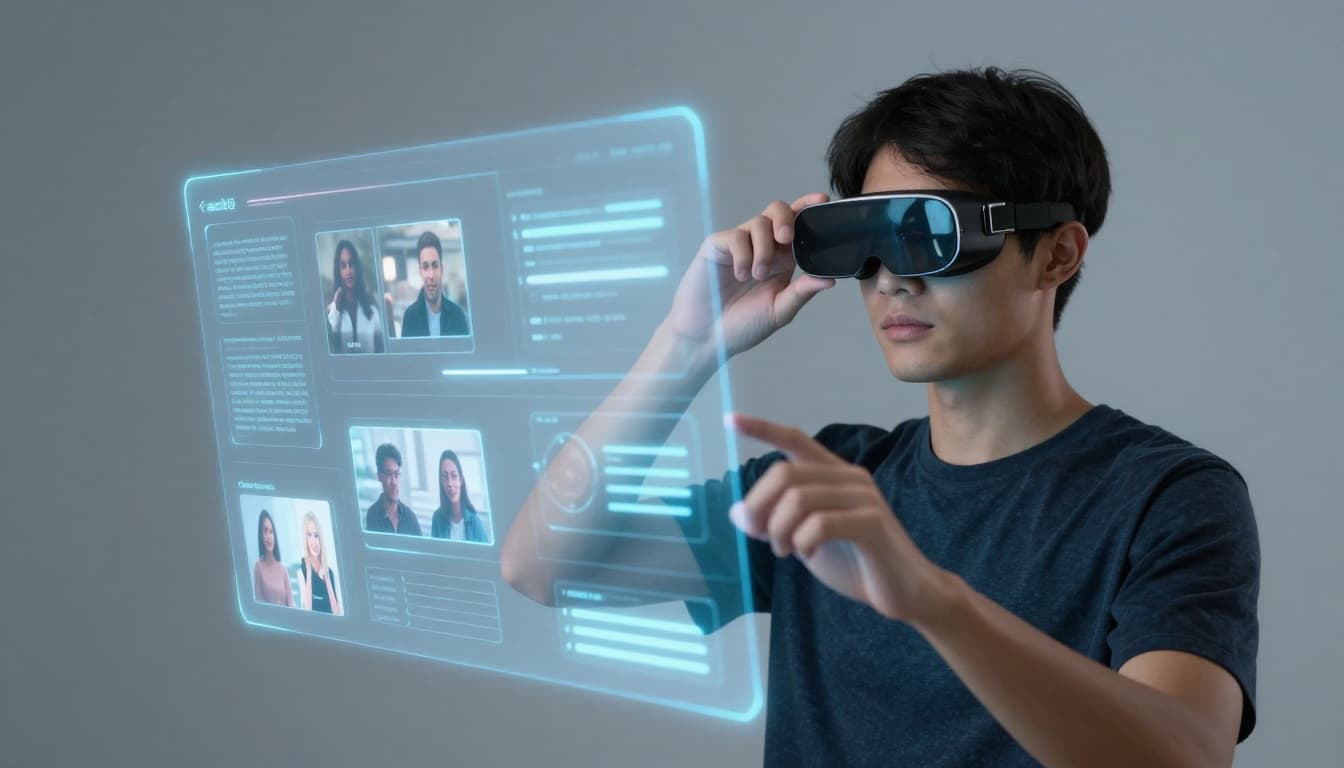
Augmented reality and virtual reality have been "the next big thing" for over a decade, but by 2030 the hardware and software will finally converge to make immersive social experiences genuinely mainstream. Meta's continued investment in Reality Labs, Apple's Vision Pro ecosystem, and competition from Samsung, Google, and emerging players are driving headset prices down while quality improves dramatically. By 2030, lightweight AR glasses that look like normal eyewear will be widely available at consumer price points, and a significant portion of social media consumption will happen through spatial interfaces rather than flat screens. For creators, this means an entirely new content format — three-dimensional, interactive, and spatially aware. Imagine a cooking tutorial where the recipe floats in your kitchen while a holographic chef demonstrates techniques beside your actual stove. Imagine a travel vlog where viewers can look around the destination in 360 degrees, exploring at their own pace. Imagine a fitness creator whose workout appears in your living room, adapting to your available space. The creators who begin experimenting with 3D content creation tools, spatial storytelling techniques, and immersive format design now will have a massive head start when AR and VR social platforms reach critical mass. This is not about abandoning current formats — it is about adding spatial content skills to your repertoire before they become essential.
Prediction 2: AI-Generated Feeds Will Replace Algorithmic Ones
Today's social media algorithms select and rank existing content to build your feed. By 2030, AI will go further — generating entirely new content tailored specifically to your interests, preferences, and emotional state. Instead of showing you the best existing video about a topic you care about, the platform will create a personalized video on that topic just for you, synthesized from multiple sources, presented in your preferred format and length, narrated in a voice you find engaging, and styled to match your aesthetic preferences. This sounds dystopian, but the technological building blocks already exist. Large language models generate text, video generation models create realistic footage from prompts, voice synthesis produces natural-sounding narration, and recommendation systems understand individual preferences with uncanny precision. The convergence of these capabilities into personalized content generation is inevitable. For human creators, this raises existential questions. If an AI can generate a perfectly personalized version of your content for every individual viewer, what value does the human creator provide? The answer lies in originality, lived experience, authentic personality, and creative vision — qualities that AI can mimic but not genuinely possess. The creators who survive the age of AI-generated feeds will be those whose humanity is their product, not just their delivery mechanism.
Prediction 3: Decentralized Social Platforms Will Gain Significant Market Share
The concentration of social media power in a handful of corporations has generated growing backlash from users, creators, regulators, and technologists. By 2030, decentralized social platforms built on blockchain and federated protocols will have captured meaningful market share, particularly among younger users and creator communities. Protocols like ActivityPub, which powers Mastodon and is being adopted by platforms like Threads, and decentralized identity systems like Bluesky's AT Protocol represent early moves in this direction. Decentralized platforms offer creators several compelling advantages over centralized alternatives. Content ownership is verifiable and permanent — you cannot be deplatformed or have your content deleted by a corporate policy change. Monetization can happen through smart contracts and tokenized fan relationships without platform intermediaries taking a percentage. Algorithm transparency is built into the architecture rather than hidden behind corporate walls. Community governance replaces corporate governance, giving users and creators genuine influence over platform rules and direction. The challenge for decentralized platforms is achieving the network effects and user experience polish that centralized platforms provide. By 2030, these challenges will be substantially solved, and savvy creators will maintain presences on both centralized and decentralized platforms — using the former for reach and the latter for ownership and community depth.
Prediction 4: Brain-Computer Interfaces Will Begin to Influence Content Consumption
This prediction is the most speculative on this list, but the research trajectory makes it worth serious consideration. Companies like Neuralink, Synchron, and numerous academic research labs are developing brain-computer interfaces that translate neural signals into digital commands. By 2030, non-invasive BCI devices — headbands, earbuds, or wearable sensors — will be commercially available for consumer applications. The initial use cases will be relatively simple: controlling a playlist with your thoughts, navigating a menu without touching a screen, or providing biometric feedback that helps the algorithm understand your emotional responses to content in real time. Imagine a social media platform that knows not just that you watched a video but how it made you feel — whether it excited you, bored you, inspired you, or upset you — based on direct neural feedback. This would make recommendation algorithms dramatically more effective, for better and worse. For creators, BCI integration means that audience analytics will eventually include emotional response data, enabling unprecedented optimization of content for emotional impact. The ethical implications are staggering, and regulatory frameworks will struggle to keep pace. But the technology is coming regardless, and creators who understand its potential will be better positioned to navigate the opportunities and challenges it presents than those who dismiss it as science fiction until it arrives on their doorstep.
Prediction 5: Holographic Content Will Emerge as a New Format
Building on advances in AR hardware and volumetric capture technology, holographic content will emerge as a distinct social media format by 2030. Volumetric video — which captures a subject in three dimensions, allowing viewers to see them from any angle — is already being produced by studios with specialized camera rigs. By 2030, consumer-accessible volumetric capture will be possible using smartphone LiDAR sensors and AI reconstruction, enabling ordinary creators to produce holographic content without studio equipment. Social media platforms will support holographic posts that viewers can experience through AR glasses, seeing the creator or their content projected into physical space. The applications are transformative for certain content categories. Product reviewers could show items that viewers can examine from every angle and at any scale. Educators could present complex 3D concepts — molecular structures, architectural designs, mechanical systems — as interactive holograms. Musicians could perform in fans' living rooms. Fashion creators could showcase outfits that viewers can walk around. This format will not replace flat video immediately, but it will emerge as a premium content type that differentiates forward-thinking creators. Early experimentation with 3D scanning apps, volumetric capture tools, and spatial content platforms will give pioneering creators a significant advantage as holographic social media moves from novelty to mainstream expectation.
Prediction 6: The Follower Model Will Decline in Importance
The concept of following an account to see their content is already being eroded by interest-based algorithms, and by 2030 the follower model will be substantially diminished as the primary mechanism for content distribution. TikTok demonstrated that a platform could thrive without strong follow-based relationships — its algorithm delivers content based on interest signals rather than social connections, and followers serve more as social proof than as distribution guarantees. Instagram and YouTube are moving in the same direction, with algorithmically recommended content from unfollowed accounts consuming an increasing share of feed real estate. By 2030, the dominant distribution model will be purely interest-based, where each piece of content is evaluated independently and served to the audience most likely to engage with it, regardless of whether they follow the creator. This shift has profound implications for creator strategy. Building a follower base will become less valuable than building a content library that consistently performs well with algorithmic distribution. Brand recognition and distinctive creative identity will matter more than follower counts because they ensure that viewers recognize and trust your content when the algorithm surfaces it, even without a follow relationship. Creators who have over-indexed on follower acquisition at the expense of content quality will find their distribution declining, while those who prioritized making excellent content will thrive in the new interest-first paradigm.
Prediction 7: Subscription-Based Social Networks Will Flourish
The advertising-based business model that has dominated social media for two decades is showing cracks. Users are increasingly resistant to ads, platforms are running out of ad inventory to sell, and regulatory pressure on targeted advertising is intensifying globally. By 2030, subscription-based social networks will be a significant and growing segment of the market. Platforms like Substack, Patreon, and membership communities have already proven that users will pay for content and community access when the value proposition is clear. By 2030, this model will expand to full social networks where users pay a monthly fee for an ad-free experience with premium features, and creators are compensated directly from subscription revenue based on engagement and content quality. This shift aligns creator and platform incentives in ways that the advertising model never could. In an ad-supported model, the platform's incentive is to maximize time on platform, which often means optimizing for addictive, sensational, or outrage-driven content. In a subscription model, the platform's incentive is to deliver enough value that users continue paying, which favors quality, depth, and genuine utility. For creators, subscription platforms offer more predictable revenue, deeper audience relationships, and freedom from the volatility of algorithmic distribution and advertiser preferences. Building skills in community management, exclusive content creation, and direct audience monetization will be increasingly valuable as this model gains traction.
Prediction 8: AI Co-Creators Will Become Standard Creative Partners
By 2030, AI will not just assist creators — it will function as a genuine creative partner that contributes ideas, generates draft content, provides real-time feedback, and handles technical execution while the human creator focuses on vision, voice, and strategic direction. The relationship between creator and AI will resemble a collaboration between a creative director and a skilled production team, with the AI handling tasks that currently require multiple human specialists. An AI co-creator might watch your recent videos, identify patterns in what your audience responds to most positively, suggest topics for future content, write first drafts of scripts that match your style, generate B-roll footage for your video essays, compose background music that fits the emotional arc of your narrative, and optimize your posting strategy across platforms — all while learning and improving from your feedback on each output. This is not replacement — it is augmentation that enables individual creators to produce content at a quality and scale previously achievable only by well-funded production teams. The creators who learn to collaborate effectively with AI partners, providing clear creative direction while leveraging AI capabilities for execution, will have an enormous competitive advantage over those who either resist AI entirely or delegate their creative vision to it completely.
Prediction 9: Spatial Computing Will Transform Content Creation Workflows
Apple's Vision Pro and its successors, Meta's Quest ecosystem, and competing spatial computing platforms will transform not just how content is consumed but how it is created. By 2030, creators will use spatial computing interfaces to edit video in three-dimensional workspaces, arrange social media content on virtual walls and timelines, collaborate with team members and AI assistants in shared virtual environments, and preview how their content will look across different platforms and devices without leaving their creative workspace. The productivity gains from spatial computing for creative professionals are potentially enormous. Imagine editing a video where your timeline stretches across your entire field of vision, with clip previews arranged spatially for instant visual reference. Imagine designing a social media campaign by arranging posts on a virtual wall, dragging and rearranging them with natural hand gestures, seeing how each piece fits into the broader narrative. Imagine having a strategy meeting with your AI agent visualized as a virtual assistant standing beside your virtual content board, discussing performance data displayed as interactive three-dimensional charts. These are not fantasy scenarios — they are direct extensions of capabilities that spatial computing platforms are already developing. Creators who adopt spatial computing tools early will discover workflows that make traditional screen-based creation feel primitive by comparison.
Prediction 10: Global Regulatory Changes Will Reshape Platform Power
The regulatory environment for social media is tightening worldwide, and by 2030 significant new rules will fundamentally reshape how platforms operate, how algorithms function, and how creator economics work. The European Union's Digital Services Act and AI Act are already setting global precedents. The United States, despite its traditionally laissez-faire approach to tech regulation, is moving toward comprehensive social media legislation. Countries across Asia, South America, and Africa are developing their own regulatory frameworks. By 2030, expect mandatory algorithm transparency requirements that force platforms to explain why specific content is recommended. Expect data portability rules that allow creators to move their audience and content history between platforms. Expect age verification requirements that change how platforms design for younger users. Expect AI labeling mandates that require disclosure when content is generated or substantially modified by artificial intelligence. And expect creator labor protections that establish minimum monetization standards and prevent arbitrary deplatforming without due process. These regulations will reduce platform power, increase creator independence, and fundamentally alter the competitive dynamics of the social media industry. Creators who stay informed about regulatory developments and adapt their strategies accordingly will navigate these changes smoothly, while those who ignore the regulatory landscape will be caught off guard by sudden shifts in platform rules and capabilities.
Conclusion
The social media landscape of 2030 will be dramatically different from what we know today, shaped by advances in artificial intelligence, spatial computing, decentralized technology, and regulatory frameworks that have not yet been written. These ten predictions — from AR/VR social experiences and AI-generated feeds to brain-computer interfaces and the decline of the follower model — are grounded in technological trajectories that are already visible and accelerating. For creators, the message is clear: the skills and strategies that work today will not be sufficient for tomorrow. Building adaptable, technology-forward creative practices now — experimenting with emerging formats, learning new tools, diversifying across platforms, and developing the uniquely human qualities that no AI can replicate — is the best insurance against a future that will arrive faster than anyone expects. The creators who thrive in 2030 will be those who started preparing in 2026.